

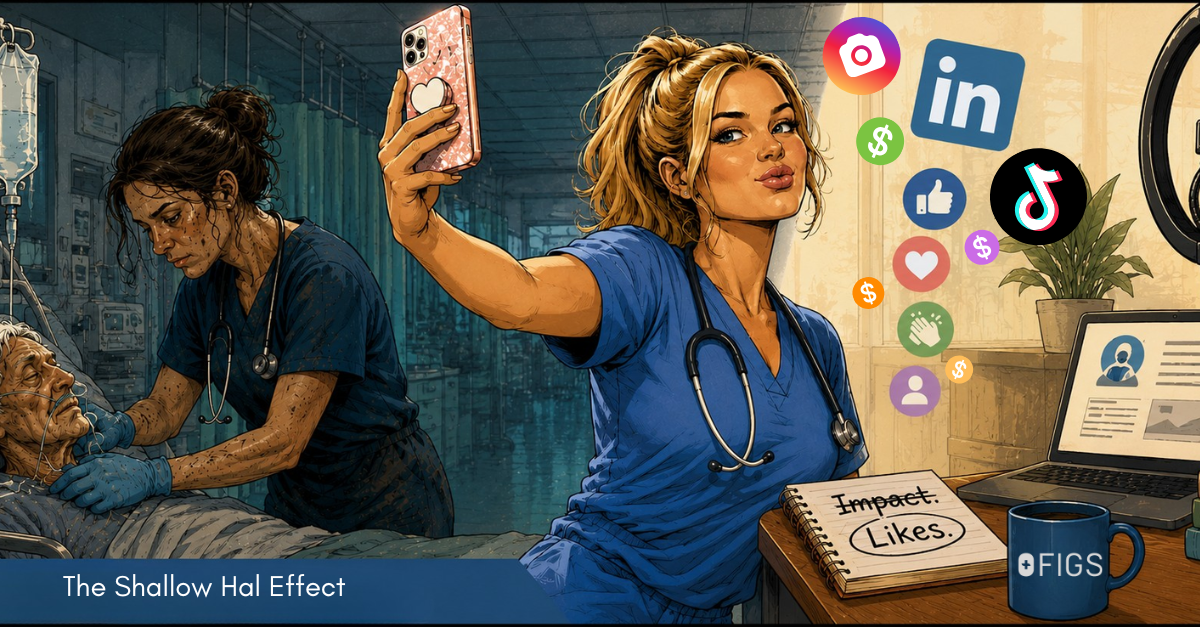
I was speaking to a good friend and the topic of Nurse social media influencers came up. You know the ones that jump on any topic that will get them attention, but never actually create change! The topic stuck in my head for a few weeks and I saw a brand name scrub company put an actor on their payroll to help "advocate" for nuring. And than another topic arose only to find out some of our own would only lend their influence for the right price!
In the 2001 film, "Shallow Hal", Hal Larson sees only what he wants to see. Hypnotized into perceiving inner beauty as outer beauty, he falls for a woman the world has dismissed, not because he has grown morally, but because he has been given a lens that flatters his own comfort. When the spell is broken, he has to choose: the easy illusion, or the harder truth.
I think about that film a lot when I scroll through what passes for nursing influence these days.
There is a particular kind of professional performance that has taken hold in the nursing space online. It has the cadence of leadership, it uses the vocabulary of advocacy, it produces content at scale, commands an audience, poses for pictures with it's fans, and given time to speak as experts even though there is nor expertise. It is photographed in front of things. It knows how to work a caption.
And when you look closely at what it has actually built or what it has shifted, you often find very little of substance underneath.
That is the Shallow Hal Effect. The optics of depth. The performance of impact. The illusion of motion in a profession that desperately needs to move.
Influence Is Not the Same as Impact
We conflated two things, and we did it fast. Somewhere between the rise of social media and the normalization of personal branding as a professional strategy, the nursing profession started measuring influence by reach, follower counts, impressions, engagement rates, and keynote invitations.
These are not measurements of impact. They are measurements of visibility. And visibility, without the structural work underneath it, is just exposure.
Real impact in nursing looks like changed policy. It looks like a curriculum that was redesigned not just for accreditation, but for real influence and meaningful outcomes. A workforce pipeline that now functions differently and gives access to a community that had none. A young nurse from a background this profession has historically ignored who found a door held open by someone with actual power who chose to use it.
Impact is slow, contested, and often invisible. It does not photograph well, and unfortunately rarely trends in todays nursing.
"The profession does not need more people with a degree in performative advocacy. It needs more people doing the unglamorous work of actually changing something."
What the Aesthetic of Influence Actually Sells
What the new wave of nursing influencers has productized, in many cases, is aspiration. The idea that you too can be a thought leader. That your story, packaged correctly, is a brand. That showing up consistently online, saying the right things to the right audience, is a form of service.
Some of it is genuine. I have several colleagues that are doing both the work and the outreach through a notible social media presence.I want to be clear about that. There are nurses doing real, courageous work who have built platforms to amplify it, and the platform serves the work. That is not what I am describing.
What I am describing is the inversion: people who built the platform first and are now reverse-engineering a rationale for why the platform itself is the contribution. The content is the advocacy. The audience is the community. The brand is the mission.
This is not a nursing problem exclusively. But nursing is a profession with a history of having its identity shaped by external forces: by institutions, by medicine, by policy makers, by a public that has never fully understood what nurses actually do. We have fought hard for decades to define ourselves on our own terms.
We should be more careful about who we hand that work to.
The Metric That Does Not Get Tracked
Here is what I have never seen in any influencer nursing content: a clear accounting of what changed because of it.
Not what inspired someone. Not what someone found motivating. Not what got shared widely and generated a good comment thread. But, what actually changed. What decision was made differently. What structure shifted. What person, community, or policy is different because this particular nurse built this particular platform.
That metric is hard to track. I understand that. Systemic change is diffuse, nonlinear, and rarely attributable to a single actor. But the absence of any engagement with that question, any attempt to locate the work in outcomes rather than outputs, is telling.
Outputs are posts. Outputs are speaking engagements. Outputs are podcast episodes and LinkedIn articles and newsletter subscribers. Outcomes are what those outputs produce in the world beyond the feed.
The nursing profession has enough outputs. We are suffering from an outcome deficit.
The Shallow Hal Checklist
- Large platform, no traceable policy or practice change it produced
- Speaks frequently about problems the profession already agrees are problems
- Community is an audience, not a constituency with organized power
- Content is inspirational; it does not assign accountability or name systems
- Revenue model is the platform itself: courses, coaching, speaking, sponsorships
- Rarely seen in rooms where actual decisions about nursing are made
- Criticism of the profession is generic; specific institutions are rarely named
Why the Profession Rewards This
The uncomfortable question is not why this kind of influencer exists. Of course they exist. Every profession has them, and social media has made the conditions optimal for their proliferation. The uncomfortable question is why nursing rewards them so readily.
We give them keynotes. We feature them in journals. We celebrate their follower counts as if followers were a proxy for expertise. We hand them the microphone in conversations that should be shaped by people who have done the structural work.
Part of the answer is that the structural work is not visible. The nurse who spent three years working a bill through a state legislature, the one who redesigned a the curriculum from the ground up for it's inclusivity, the one who organized a community health program in a neighborhood no one else would go into: none of that looks like leadership to a profession that has been trained to recognize leadership by its aesthetics.
We have internalized a very particular image of what a nursing leader looks like. It is polished. It never challenges. It appears confident. It has a strong presence in leadership circles and a clear personal brand, often tied to an established or should I say establishment institution. It gives good sound bites.
That image is useful for recruitment materials. It is not a reliable map to the people actually moving things forward.
The Spell and the Choice
At the end of the film, Hal has a choice. He can go back to seeing only what flatters him, or he can accept a more complicated truth and act from it.
The profession has the same choice. We can keep optimizing for the content that performs well and calling it advocacy. We can keep celebrating reach as if it were impact, and platforms as if they were power. We can keep mistaking the aesthetics of leadership for the actual work of it.
Or we can get honest about what we are measuring and why. We can start asking harder questions of the people we amplify. Not just: how many followers do you have? But: what has changed because of your work? Who has power now that did not before? What did it cost you to do that? What did you build that will outlast your platform?
Those questions will not always produce satisfying answers. The real work rarely does. But they are the right questions for a profession serious about its own future.
The needle does not move because someone went viral. It moves because someone stayed in the room when the room was difficult, pushed on something that pushed back, and kept going anyway.
That is harder to photograph. It is also the only thing that actually counts.
Influence borrowed from a platform you did not build to serve a mission you have not tested is not leadership. It is content. The profession deserves to know the difference.
