

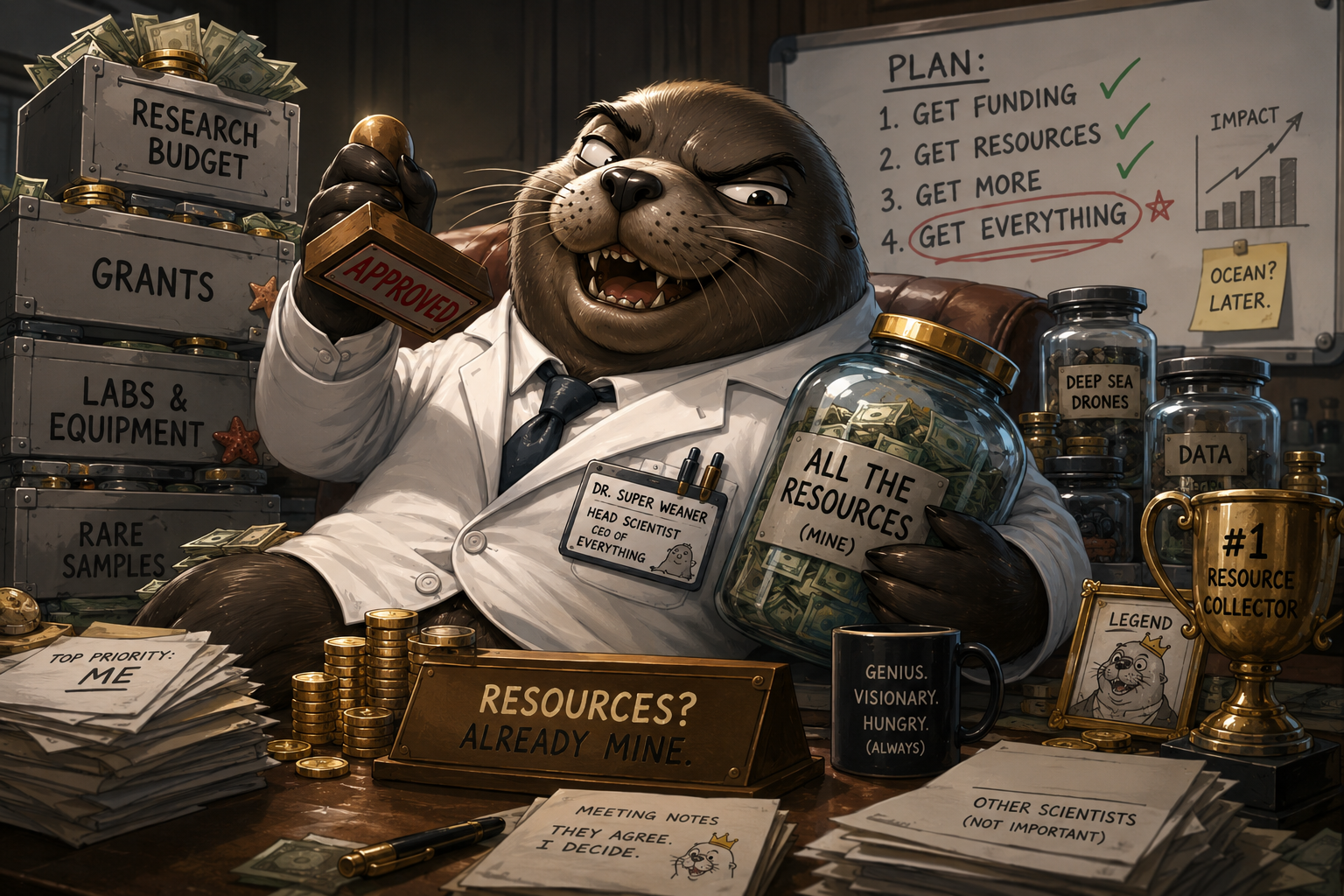
There is a phenomenon in northern elephant seal colonies that marine biologists call "double mother suckling." A pup, typically through opportunism, stealth, or the exploitation of a distracted mother, manages to nurse from two different females simultaneously. The result is dramatic. While the average weaned pup leaves the rookery at roughly 300 pounds, the double mother suckler can reach nearly 600 pounds before it ever touches open water. It looks healthy. It looks strong. It is, by every external measure, thriving.
But something else is happening beneath the surface of that success. Two mothers are being depleted. Two sets of legitimate pups are receiving less than their biological share. The resources of the colony, finite and costly, are being concentrated in one body that did not earn them by right but by maneuver. The ecosystem does not celebrate the double mother suckler. It absorbs the damage and keeps moving, because it has no other option.
I have been a nurse long enough to recognize that pup.
What Extraction Looks Like in Professional Clothing
We do not usually use the language of extraction in nursing. We prefer softer framings: mentorship, networking, collaboration, building your brand. These are not inherently dishonest words. But they become dishonest when they are used to describe something that is, functionally, consumption without contribution. There is a category of senior nurse in this profession who has mastered the art of nursing from multiple sources without ever giving back in return.
They sit in every room where ideas are generated. They absorb those ideas, let them gestate in institutional silence, and then present them later under their own byline, in their own presentations, to their own applause. They volunteer for committees not to do committee work but to extract intelligence, positioning, and credit. They accept mentorship from younger nurses who bring energy, current clinical knowledge, and fresh frameworks, and they offer in return the performance of access that rarely materializes into anything concrete. They collect fellowships, board seats, and keynote invitations like growth rings, each one representing another feeding opportunity, another source from which they drew without depositing.
The double mother suckler does not see itself as taking. It has simply learned that the colony will not stop it. In nursing, we have built a profession that not only permits this behavior but rewards it with credentials, visibility, and institutional trust.
This is not about ambition. Ambition is generative. This is about accumulation in the absence of reciprocity. It is the difference between a nurse leader who grows powerful while growing the people around her, and one who grows powerful by preventing the people around her from growing at all.
The Ecology of Depletion
Marine biologists are precise about what the double mother suckler costs the colony. It is not just two mothers who are compromised. It is the downstream effect: pups who enter the ocean at suboptimal weight, with less reserve, less resilience, less capacity to survive the first independent season. The damage compounds in a direction that is invisible from the shoreline but catastrophic in the deep water where it matters.
The same arithmetic applies in nursing. When a senior nurse extracts ideas from junior colleagues without attribution, those colleagues lose not just credit but the developmental momentum that comes from being seen as a thinker. When a nurse leader absorbs a mentee's network, energy, and original work, the mentee loses access to the very capital that was supposed to be the return on their investment in the relationship. When a board member occupies a seat at a professional organization primarily for visibility rather than governance, the organization loses both fiduciary attention and the seat that could have gone to someone who would have shown up fully.
These losses are hard to document. They do not appear in any performance review. They do not generate grievances or formal complaints. They are simply the quiet absence of what should have been there, felt most acutely by the nurses who deserved more and received less because someone else took two portions.
Why the Colony Tolerates It
This is the part that deserves real examination. The northern elephant seal colony does not have an enforcement mechanism sophisticated enough to prevent double mother suckling. But nursing does. We have professional codes of ethics, governance structures, mentorship frameworks, publication standards, and credentialing bodies. We have, in other words, every institutional instrument necessary to name and address this behavior. We simply choose not to use them for this purpose.
Part of the reason is that the double mother suckler is often senior enough to define what the norms are. They sit on the committees that set the standards. They write the ethics statements. They deliver the keynotes about the importance of supporting the next generation of nurses while their actual behavior in professional spaces tells a different and quieter story. Confronting them requires confronting the legitimacy of the very structures they helped construct, and most institutions are not willing to do that.
Part of the reason is that extraction in nursing is gendered and generational in ways that make it difficult to name without being dismissed. When a younger nurse, often from a minoritized community, which in nursing is almost everyone except the singular dominent group, raises a concern about idea appropriation or credit theft, they are frequently told they are misreading the situation, that collaboration is inherently shared, that being generous with your thinking is a virtue. These framings are not entirely false. They are, however, used selectively, against the people who can least afford to absorb the cost, often sacrificed because they have a their entire careers to build a portfolio.
We tell junior nurses to share freely, to collaborate openly, to bring their whole intellectual selves into professional spaces. We do not always tell them that some of the people in those spaces have learned to eat well by doing so.
What Super Weaning Actually Produces
The marine biology literature notes something important about the super-weaned pup: its extraordinary size is not an advantage. It is a liability. The pup enters the water carrying mass it was never designed to carry, built from a feeding pattern that trained it for extraction rather than for the independent competencies it would need to survive. The double mother suckler, in the end, is not more capable than its peers. It is heavier. There is a difference.
I think about this when I see the curriculum vitae of a certain kind of senior nursing leader: page after page of publications, presentations, boards, fellowships, awards, and honors, stacked so high that the document itself becomes a form of argument, a demand to be taken seriously before anyone has read a word of what they have actually produced. The weight is real. The mass is real. But if you look closely at the sourcing, at who contributed to what, at which ideas originated where and how they traveled from junior colleague to named author, you sometimes find something that the CV does not document. You find two mothers who are not in the acknowledgments. Research has even found the nursing profession having high prevelance of inappropriate authorship in nursing journals, with one study indicating over one-third of articles examined had inappropriate authors, often due to pressures to include senior faculty, deans, and nursing leaders. No one is probaly looking at the number of presentations at conferences that end up with a few add-ons!
The profession needs to ask itself what it is actually credentialing when it elevates these figures. It needs to ask whether the mass it is rewarding was accumulated through contribution or through consumption. Because those are not the same thing, and the pups who were depleted to produce it are still out there, entering deep water with less reserve than they should have had.
- Junior nurses lose attribution, momentum, and the developmental return on intellectual generosity
- Mentorship relationships become sites of resource transfer rather than reciprocal growth
- Board seats and governance roles are occupied by accumulators rather than contributors
- Publication records obscure the actual origin of ideas and the labor behind them
- The profession credentials mass rather than capacity, and calls the difference leadership
What Reciprocity Looks Like Instead
I want to be precise here, because this essay is not an argument against ambition, seniority, or professional achievement. There are senior nurses in this profession who have grown large because they grew everything around them at the same time. They are recognizable not by what they have accumulated but by what they have left behind: nurses who are better thinkers, better writers, better advocates because of sustained and honest investment. Their mentees get credited. Their collaborators get named. Their committees produce governance rather than positioning. Their fellowship applications read like contributions rather than collections.
Reciprocity in professional nursing is not complicated. It looks like giving credit when an idea originated with someone else. It looks like declining the keynote invitation and suggesting the junior colleague who developed the work. It looks like mentorship that costs you something, that requires you to make space rather than to take up more of it. It looks like sitting on a board and doing board work rather than collecting the affiliation. It looks like a professional relationship in which both parties leave the encounter with more than they entered it.
The colony sustains itself through reciprocal feeding. Every nursing generation has been carried, at least in part, on the milk of those who came before. The obligation of that gift is not to hoard it. It is to produce it for the ones who come next.
We do not need more well-fed pups at the top of this profession. We need a colony that stops tolerating the behavior that produces them, and starts asking what it cost everyone else to get them there.
