

Is the Federal Government Deliberately Reshaping the Nursing Workforce?
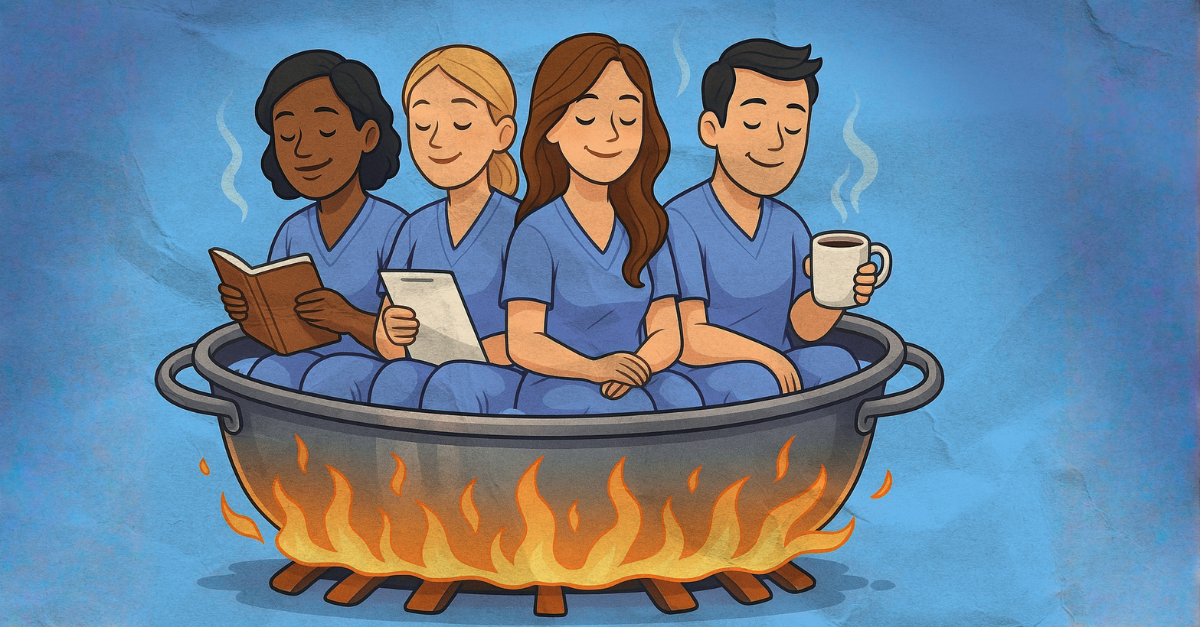
Is the Nursing Workforce the "Boiling Frog"
Originally Published on LinkedIn Nov 2025
I'm not sure if everyone realizes how much the Nursing workforce has been targeted by the federal government this year and the impact it will have on the profession of nursing. A brief conversation with a workforce strategist and friend today alarmed me as I had not looked at the cumulative effects of what the current administration is doing to the nursing workforce, not to mention the impact it will have on the future of population health and healthcare...
The nursing profession is being reshaped by a series of federal decisions that restrict who can enter the field, who can advance, and who will be available to care for patients in the coming decade. These changes are not isolated events. Together, they form a pattern that slows the production of nurses, weakens the evidence base that guides practice, and reverses years of progress in diversity and workforce development.
Significant cuts to the National Institute of Nursing Research have slowed the scientific engine that supports safer staffing, community based care, symptom science, maternal health, chronic disease management, and veteran suicide prevention. Over the next ten years, these cuts are projected to reduce the nurse scientist pipeline by thirty to fifty percent and delay research essential to improving care in underserved communities.
HRSA’s Nursing Workforce Diversity grants, which have long supported low income and underrepresented students, were eliminated in recent budget proposals. These programs consistently increased diversity enrollment by twenty to thirty percent in funded schools. Without them, nursing programs are projected to see a thirty to forty percent decline in students from underrepresented backgrounds within five years. This moves the profession backward at a time when demographic alignment with communities is critical to health equity.
The administration also suspended the federal nursing home staffing mandate for ten years. This decision protects facility operators but leaves residents and staff in chronically understaffed environments. It also removes one of the few regulatory pressures that could have created thousands of new RN jobs and pushed wages upward for long term care nurses.
At the same time, restructuring within HHS has reduced internal capacity for public health programs, rural health initiatives, and workforce development grants. Combined with new restrictions on DEI related funding, academic institutions and health systems have lost crucial support mechanisms that once strengthened training pipelines, mentorship programs, and partnerships with disadvantaged communities.
These collective decisions are already shaping the future workforce. Based on current trends, the United States is expected to graduate three hundred fifty thousand to four hundred fifty thousand fewer registered nurses over the next decade. Nearly one million nurses are projected to retire by 2035. When the losses from reduced training pipelines, reduced faculty production, and stalled diversity efforts are added together, the country is moving toward a deficit that could exceed one million nurses.
The newest and perhaps most widely felt policy change involves the federal loan overhaul. The “One Big Beautiful Bill” created two categories of graduate education and kept nursing outside the professional degree category and removed the verbiage that previously left that door ajar for nursing. Borrowing limits for nursing graduate students are now far below the cost of most MSN, DNP, CRNA, CNS, and PhD programs. The upcoming elimination of Grad PLUS loans in 2026 removes the only remaining federal option that allowed nurses to borrow up to the full cost of attendance. This single change is expected to reduce graduate nursing enrollment by fifteen to twenty five percent within five years and may result in the loss of up to two hundred fifty thousand advanced practice nurses by 2036.
Taken together, these policies weaken the profession from multiple directions. They limit diversity, reduce evidence generation, shrink the faculty workforce, restrict advanced practice pathways, and create long term shortages that every patient in America will feel. Nursing is essential to the stability of the health care system. The decisions being made today are creating the shortages of tomorrow, and the nation must recognize what is at stake before the consequences become irreversible.
*The percentages are rough estimates based on an interview of a workforce expert
