

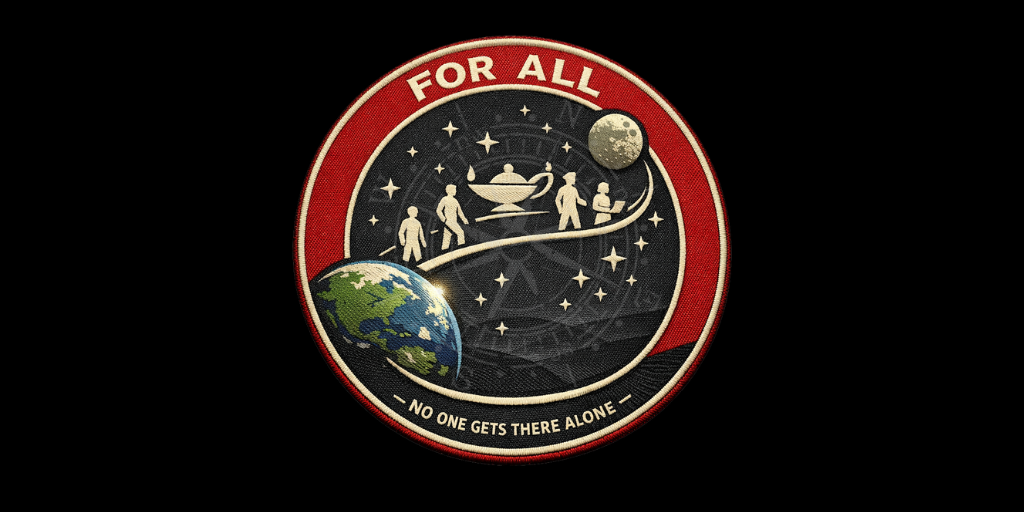
While I was working I had my tablet broadcasting the Artimis II Launch, reaching the Moon, and return to home. The Artemis II crew splashed down in the Pacific, completing humanity's first crewed journey to the Moon's vicinity in more than fifty years. Reid Wiseman commanded. Victor Glover flew as pilot. Christina Koch and Jeremy Hansen served as mission specialists. Glover was the first Black astronaut to travel this far from Earth. Koch was the first woman. Hansen was the first Canadian. The spacecraft was powered by a service module built across ten European countries, designed and integrated by Airbus in Bremen, Germany, and representing nearly a decade of coordinated industrial effort. The mission succeeded because people who came from different nations and different areas of expertise operated with a shared commitment to the mission and a genuine investment in each other's success.
I want to sit with that for a moment before moving on to nursing, because we have a tendency in professional discourse to acknowledge the Artemis model as inspiring and then return to our usual habits as though inspiration were enough. It is not. What happened over the last ten days in space was not inspirational in the motivational-poster sense. It was structural. The Artemis program was designed from the beginning to make mutual dependence not just acceptable but unavoidable. No single nation could run this mission alone. No single crew member had all the expertise the mission required. The collaboration was not a cultural aspiration layered on top of the real work. It was the engineering specification.
Nursing has the exact opposite problem. The real work of nursing, caring for patients across every setting, every specialty, every point in the lifespan, requires exactly the kind of mutual dependence that Artemis built in. But the culture nursing has inherited, and too often continues to reproduce, treats that dependence as vulnerability rather than strength. The new nurse is a threat to the experienced nurse's authority. The nurse from another country carries knowledge that is treated as suspect rather than additive. The nurse who rises into leadership is sometimes viewed as having abandoned bedside practice rather than extended nursing's presence in the rooms where decisions are made. Our practice is often threatened by our physician counterparts through words like scope creep, as we do the same to other allied health partners. The crew, in too many nursing environments, still eat their young and question it when they leave the profession.
"Together, we are demonstrating that cooperation remains our most powerful engine for the future."
Josef Aschbacher, ESA Director General, April 2026
This Is Not a New Observation. That Is the Problem.
The phrase "nurses eat their young" has been part of the profession's vocabulary for decades. It appears in nursing journals, in orientation programs, in the quiet warnings that experienced nurses give to new graduates before they walk onto a unit for the first time. The fact that we named it long ago and it persists anyway tells us something important: this is not a knowledge problem. Nursing knows the culture is damaging. The evidence on lateral violence, horizontal hostility, and toxic workplace dynamics in nursing is not thin or contested. It is substantial, well-documented, and has been accumulating for years. The problem is not that we do not see it. The problem is that the structures we have built do not consistently interrupt it.
Artemis offers a model not because it achieved perfect harmony among its participants, because that would be a romantic and inaccurate reading, but because it built structures that made collaboration the path of least resistance. When the European Service Module provides the propulsion, the power, and the life support for the entire mission, there is no scenario in which the American crew dismisses European expertise as secondary. The interdependence is not aspirational. It is physical. The mission dies without it. What nursing has not yet done is build professional structures that make the same demand, structures where interdependence is not a value statement but a functional requirement, where the dismissal of a colleague's contribution is visibly self-defeating rather than quietly tolerated.
Every Strength in the Room Belongs to the Mission.
One of the things I find most instructive about the Artemis II crew is not just that it was diverse in its composition, but what that diversity actually meant in practice. Glover brought experience as a naval aviator and a previous International Space Station mission. Koch brought experience from the longest single spaceflight by a woman in history and expertise in electrical engineering. Hansen brought the perspective and training of the Canadian Space Agency and a background in astrophysics. Wiseman brought command experience and extensive EVA training. None of those backgrounds were redundant. None of them were ranked against each other in a hierarchy of legitimacy. Each one made the mission more capable than any single background could have made it alone.
Nursing has this resource in abundance and we squander it constantly. The internationally educated nurse who trained in a system where clinical autonomy was the expectation from day one carries knowledge about independent practice that most domestically trained nurses have never been asked to draw on. The LPN with fifteen years of bedside experience has developed clinical pattern recognition that cannot be downloaded from a textbook, and yet the professional culture frequently signals that this experience is less credible than a credential. The nurse who came to the profession as a second career brings contextual intelligence from another field that could cross-pollinate nursing practice in ways we have barely begun to explore. We have the crew. We are just not flying like one.
Uplifting Is Not Soft. It Is Strategic.
There is a version of this conversation that gets framed as a call for niceness, for a more supportive workplace culture in the way that a motivational calendar is supportive. That is not what I am arguing, and the Artemis model is not what I am pointing to. What the Artemis program demonstrates is that uplifting the capabilities of every partner is not a gesture of goodwill. It is a mission requirement. When ESA Director General Josef Aschbacher said that cooperation is the most powerful engine for the future, he was not offering a sentiment. He was describing the engineering reality of how the mission got off the ground.
When nursing leaders invest in the development of new nurses with the same intensity they invest in protecting established norms, the mission gets stronger. When a nursing organization chooses to amplify the work of a smaller or newer organization rather than treat it as competition for limited attention, the profession's reach expands. When a nurse manager creates conditions where a nurse who sees something wrong can say so without fear of social punishment, the patient outcomes improve, because the crew is actually communicating. None of this is soft. It is the difference between a mission that functions and one that fails at altitude because the systems were not actually talking to each other.
The Toxic Environment Is the Mission Risk.
There is a direct line between nursing's documented workplace culture problems and nursing's documented workforce crisis. Nurses are leaving the profession, leaving units, leaving healthcare entirely, and the research on why is not ambiguous. It is not primarily pay, though pay matters. It is the experience of working in an environment that treats its own people as expendable, where asking for help signals weakness, where a new nurse's mistake becomes a social event rather than a learning moment, and where the hierarchy of experience is used not to mentor but to enforce deference. You cannot sustain a workforce in those conditions, and you cannot build a coalition under them.
Imagine for a moment that the Artemis II crew operated the way nursing units too often operate. Imagine that the American astronauts signaled, subtly or directly, that the Canadian astronaut needed to prove himself before his input would be taken seriously. Imagine that the European engineers who built the service module were treated as contractors rather than partners, their expertise acknowledged in the program documents and dismissed in the daily decisions. Imagine that the flight controllers in Houston protected their domain by withholding information from the crew rather than flooding them with everything they needed to succeed. The mission would not have reached the Moon. The crew would not have come home.
Nursing's mission, caring for human beings across the full span of health and illness, is no less complex and no less high-stakes than a lunar flyby. The argument for building the kind of culture that Artemis demonstrated is not idealistic. It is as practical as heat shield engineering. The toxic environment is not a cultural problem separate from the clinical problem. It is the same problem.
- Structures that make interdependence unavoidable, not just encouraged
- Leadership that treats every role as load-bearing rather than hierarchically ranked
- Onboarding built around drawing out what new nurses bring, not testing what they lack
- Cross-specialty and cross-sector relationships that compound expertise rather than silo it
- Professional organizations that amplify each other rather than compete for the same room
- A norm of uplifting that is treated as strategic investment, not optional generosity
The Mission Patch Said: For All, By All.
The official Artemis II mission patch carries the designation "AII" with a description that NASA articulated plainly: an endeavor of discovery that seeks to explore for all and by all. I do not know who wrote that language, but whoever did understood that those two phrases are doing different work. "For all" is the aspiration, the destination, the patient at the center of the care. "By all" is the architecture. It is the insistence that the mission cannot be accomplished by a subset of the people it belongs to, that you cannot build for everyone while excluding someone from the building.
Nursing's mission is healthcare for all. The "by all" is the part we are still constructing, the part where a nurse who trained in the Philippines and a nurse who trained in Texas and a nurse who is eighteen months out of school and a nurse who is eighteen years into practice are all recognized as carrying something the mission needs, where the profession stops ranking those contributions against each other and starts treating them as a portfolio. The mission patch for nursing's coalition moment has not been designed yet. But the description is already written. For all. By all. The only question is whether we will build accordingly.
Four people from two nations flew 694,000 miles and came home, carried by a machine built across ten countries, guided by thousands of people on the ground, held together by the understanding that the mission required every contribution and could afford to waste none. Nursing has that crew. We have always had that crew. What we are still deciding is whether we are willing to fly like one.
The phrase "nurses eat their young" has been in circulation longer than most current nursing students have been alive. Its persistence is not evidence that the culture cannot change. It is evidence that naming a problem is not the same as structuring against it.
Artemis did not achieve its coalition by asking people to be nicer to each other. It achieved it by making every partner's contribution structurally necessary, by designing a mission where dismissing a colleague's expertise was not a social failing but a technical one. That is the model. Not inspiration. Architecture.
